The Credit Card Your Partner Doesn't Know About
Two in five Americans in committed relationships have kept a financial secret from their partner. Here's what that silence actually costs — and what making it visible changes.
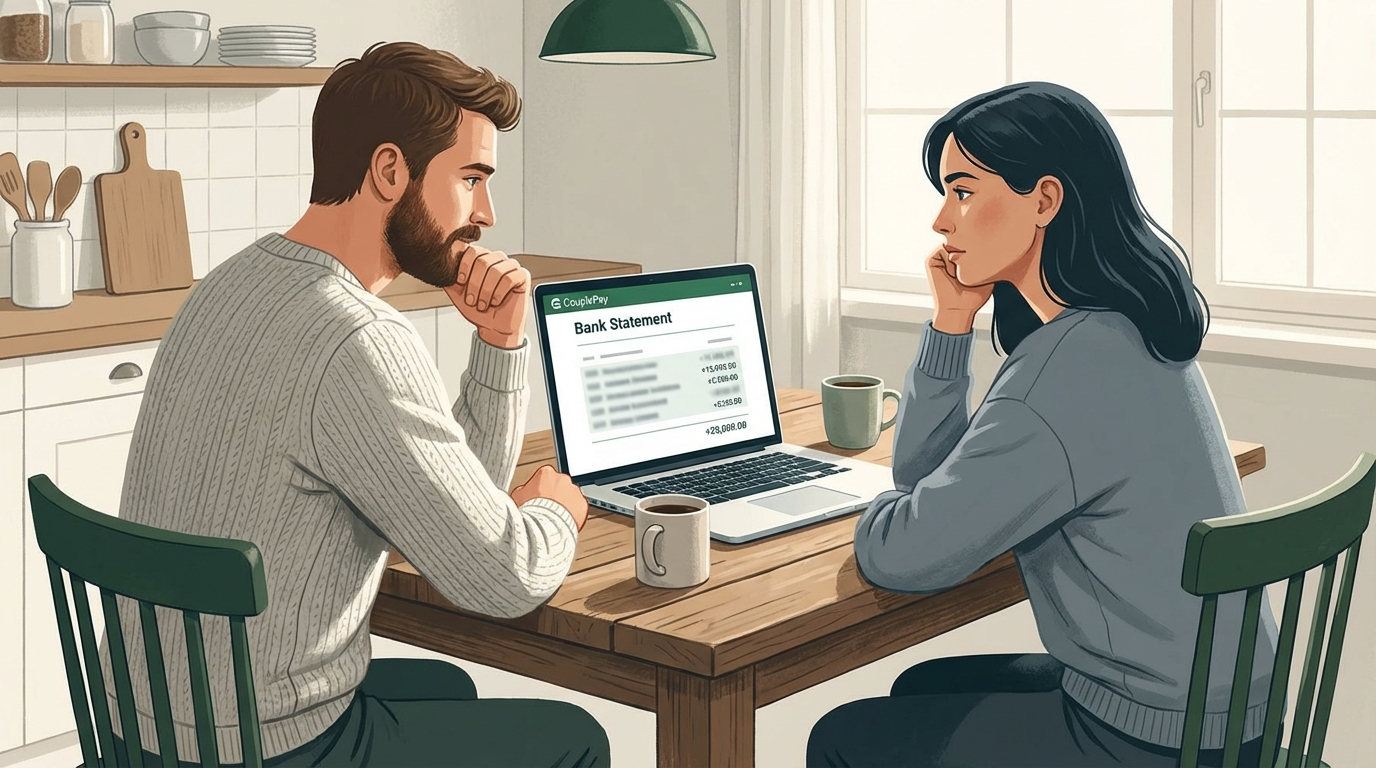
Sometimes it’s a minimum payment that doesn’t quite add up. A card statement you’ve never seen. An account you haven’t asked about because asking would mean making it real.
Two in five Americans in committed relationships have kept a financial secret from their partner. One in four has specifically hidden debt. Most of them are not monsters. They’re just scared — of judgment, of a fight, of the look on someone’s face when the number lands.
The secret doesn’t protect anyone. It just means one person is carrying the weight alone.
Why people hide it
The quiet reasons
Financial infidelity rarely starts with a calculated decision to deceive. It usually starts with something smaller:
- A bad month that turned into a bad year. The plan was always to fix it before anyone noticed.
- Shame from a past decision. One purchase, one splurge, one moment that already felt too embarrassing to name out loud.
- Avoiding a fight. The math feels unfixable right now. Starting a conversation only adds a second problem on top of the first.
- Protecting the other person. A misguided version of care — if they don’t know, they won’t worry.
- Hoping to solve it alone. If I can pay it down quietly, it won’t have to become our problem.
Every one of these is recognizable. Every one of them makes sense in the moment. And every one of them costs more than the debt itself.
What it costs — both of you
The real price of silence
More than 43% of Americans say keeping financial secrets is at least as bad as physical infidelity. Not as a moral judgment. As a measure of how much trust is involved.
Among couples who have discovered financial infidelity, the outcomes are real: 42% said it caused a serious argument, 32% reported reduced trust in the relationship, and 16% said it contributed to separation or divorce. (NEFE/Harris Poll, 2021 — the pattern holds in newer data.)
The person kept in the dark pays an obvious price. But the person hiding the debt pays too.
There is the mental load of tracking the story. The anxiety before any financial conversation. The small flinch whenever the credit card statement comes up. The growing distance — not because anything was said, but because something was not. That distance accumulates without either person naming it.
Hiding debt is exhausting. Carrying it alone is harder than paying it off together.
By the numbers
2 in 5
Americans in committed relationships have kept a financial secret from their partner
$1.277T
Total U.S. credit card debt as of Q4 2025 — the highest on record
The alternative isn’t a confrontation — it’s a conversation
What changes when you both can see it
You’re not afraid of the number. You’re afraid of the conversation.
That’s a different problem — and a more solvable one.
What changes when both people can see the same balance at the same time isn’t that the debt disappears. It’s that the weight stops being carried alone. The story stops needing to be managed. The anxiety before financial conversations loses its grip.
CouplePay is built for exactly this moment: giving couples a shared picture of their credit card debt without the judgment, without the spreadsheet negotiation, without one person feeling like they’re being audited. It’s not a confession tool — it’s a starting point for a shared plan.
Shared visibility is not exposure. It is relief.
What couples who make it through tend to do
One pattern worth noting
Couples who get through hidden debt without lasting damage tend to share one behavior: they name the number before they name a plan.
Not a proposal. Not a solution. Just: here is where we actually are.
That first moment of shared reality is harder than any payment. It’s also usually the one that makes every payment after it easier.
Sources
- Bankrate. “2 in 5 Americans in a relationship have kept a financial secret from their partner.” January 27, 2025.
- Bankrate. “More than 2 in 5 Americans believe financial secrets are at least as bad as cheating.” January 29, 2026.
- ScienceDirect. “Financial infidelity asymmetry predicts couples’ financial and relationship well-being.” July 12, 2025.
- Kiplinger. “Nearly half of adults have committed financial infidelity.” January 25, 2024.
- NEFE. “2 in 5 Americans admit to financial infidelity against their partner.” November 2021.
- LendingTree. “2026 Credit Card Debt Statistics.” Updated March 2026.
- Forbes Advisor. “Average Credit Card Debt in 2026.” December 2025.